

Five Concepts for Year-End Events in 2026
 10 min
In August, the end of the year still feels a long way off, at least on the calendar. Yet many companies are already securing December dates, venues and talent while grappling with a more difficult question: what kind of celebration will employees genuinely want to attend? Anton Savelyuk, founder and CEO of event agency iMARUSSIA!, explores five directions for the 2026 festive season and explains where an attractive theme ends and a concept that truly works begins.
For event organisers, the festive season begins in August. This is when the best December dates, venues and in-demand talent start getting booked. For our clients’ HR and in-house event teams, one question quickly becomes central: how do you create a celebration that feels contemporary, reflects the company’s identity and genuinely engages employees?
A few years ago, the answer often fitted on a single presentation slide: the 1990s, something futuristic, or a winter fairy tale. Add some décor, a host, a headline act or a cover band, plus a photo booth, and the event was considered more or less complete. Today, audiences are much harder to impress. They regularly attend professionally produced events and can easily tell the difference between a coherent creative idea and a collection of familiar devices.
The initial idea still answers the question of how the evening will look. The concept goes further: it determines what guests experience within that world, where they find themselves, what they do, how their journey develops and which moment becomes the climax.
Our team is constantly developing concepts of every kind, and we use a simple test to see whether an idea can carry a full event. Can the event be captured in one compelling image? Is there a clear creative thread that guides the guest through the entire experience? Does the finale deliver a moment that could only happen within this particular concept? Three yeses give the project a strong chance of being remembered as one of the company’s best events of the year, rather than blending into the crowded December calendar.
Below are five directions that, in my view, will be particularly visible during the 2026 festive season. They are starting points, not ready-made formulas. Each one needs to be rebuilt around the company’s character, audience mix, venue and, of course, budget.
1. A New Russian Fairy Tale
In 2026, Russian aesthetics will continue to evolve through theatre, fashion, craftsmanship, music and contemporary scenography. Imagine the opening moments of the evening. Guests enter a winter palace that seems to have arrived from the future. Ornaments move across video projections and grow to architectural scale, electronic music merges with a live choir, and the costumes resemble a collection by a contemporary Russian designer. The programme brings together modern ballet, chef-led gastronomy and one large scenic image that transforms as the evening unfolds.
The process begins by defining the cultural code. Northern ornamental traditions, lacquer miniature painting, the à la russe aesthetic and Diaghilev’s Ballets Russes would each lead to a completely different event. Choosing one visual language gives the concept a clear identity and helps connect the décor, music, costumes, menu and graphic design.
The strongest narrative material may already exist within the company’s own history. Archive content can become the prologue, the year’s achievements can form the chapters of a shared story, and award recipients can become its heroes. Keeping the tone human allows employees to recognise their own experience and feel that they helped write it.
One interesting approach would be to shift the focus away from A-list celebrities and towards a new generation of AI-created performers that have gained attention in recent years. The virtual artist Snegurochka, based on the Russian Snow Maiden, could support this concept particularly well. It would bring a fresh element to the programme while reducing the need to overspend on established Russian pop stars.
The event should have one dominant scenic image: a transforming palace, a forest of light, an enormous window, or a stage object that reveals itself in the finale. At the climax, for example, a massed choir, ballet and video content could merge into a single vision of the company’s future.
This direction works particularly well for major Russian companies, industrial brands, banks and teams with a broad age range. It offers a strong sense of ceremony, instant cultural recognition and visual scale. It can work just as successfully for an intimate dinner as for a production staged for several thousand guests.
2. Back to the Future
In 2006, the year 2026 seemed like a distant horizon. We imagined smart cities, robots, flying cars and limitless technological optimism. Reality took a different route, and that gap between expectation and experience provides rich material for a year-end event.
The visual language comes from transparent plastics, pixel graphics, early digital interfaces, silver finishes, neon and the unmistakable sound of polyphonic ringtones. Guests step into the future as it once appeared in a familiar magazine or an early-2000s music video. It is slightly naïve, highly energetic and already part of history.
The concept comes alive through an encounter between two versions of time: the future we imagined and the future we actually built. Content is the project’s main resource. The company’s advertising, photography, products and interfaces from 2006 become the starting point for a conversation about today’s achievements and the decade ahead.
Guests record messages to their 2036 selves, design magazine covers from the future and compare past expectations with present-day reality. Younger employees contribute to the story on equal terms with longer-serving colleagues. This is an important test of the concept. References that are broad enough for the whole room to recognise will connect generations; references that are too niche will turn the event into a theme party for only part of the audience.
Music holds the two eras together. Hits from the 2000s are reworked with a contemporary live sound, electronic beats are layered into orchestral arrangements, and generative graphics connect archive material with the company’s wider story. The finale could offer a collective view of 2036, built from the words and images contributed by employees themselves.
A comeback by a well-known act, such as Russian pop artists t.A.T.u., Akula or Blestyashchie, could provide the evening’s standout moment.
This direction feels especially natural for technology, telecoms, banking and FMCG companies, as well as organisations whose products, technology or culture have changed significantly in recent years.
3. SOLD OUT: The Biggest Concert of the Year
In this format, the event has its own poster campaign, a visual identity inspired by a concert tour, a backstage area, several stages and one major premiere that everyone in the room is waiting to see.
We design the guest journey before we build the artist line-up. Guests receive a ticket, pass through a content zone and immediately understand the world they have entered. An acoustic set plays in the foyer, a large-scale stage programme unfolds in the main space, and a club-style afterparty begins once the show is over. The journey is instantly legible: people have come to socialise, listen to music, dance and anticipate the evening’s headline moment.
The company’s character is revealed through the show itself. This might include employee performances developed with professional artists, short musical stories about individual teams, or an awards ceremony embedded in the programme. Putting employees on a major stage requires professional direction and serious rehearsal. When it is done properly, the audience feels genuine pride in the colleagues performing in front of them.
On iMARUSSIA! projects, we begin by deciding what will become the evening’s central moment. Sometimes it is a well-known artist. Sometimes it is a one-off collaboration that can only be seen at that particular event. Sometimes it is the employees themselves. That decision shapes the creative direction, technical production and budget allocation.
A memorable scenic solution could borrow the bold geometry of Kanye West’s concert productions, perhaps through a large half-dome. Such a structure is ambitious and costly, but it delivers immediate visual impact. Its projection surface could feature a map of the company’s offices or fill with employee portraits, turning it into a symbol of connection.
This direction suits technology, FMCG, telecoms, retail and service businesses, large sales teams, and companies with a younger or mixed-age audience. The largest share of investment is best concentrated on the stage, sound, lighting, show direction and one genuinely strong musical idea.
4. A Secret World: Invitation Only
This is the most narratively demanding direction in the collection. Guests are free to explore the venue, discover hidden scenes, choose their own route and gradually piece together a shared story. The evening feels like a journey through an unknown world, where a new narrative may begin behind every door.
The first step happens before the event begins. A symbol or a riddle appears in the invitation. At the venue, registration becomes a threshold into another world. An intimate performance takes place in one room, a live music bar opens in another, a character appears on the staircase, and an installation inside a closed library gradually reconstructs part of the company’s year. By the finale, the different routes converge and guests see the complete picture for the first time.
An event like this needs one central mystery and several ways to approach it. If every room tells an independent story, the evening quickly becomes a set of disconnected episodes. The routes should therefore be designed backwards from the finale. The creative team first defines what people should understand, feel or see when everyone comes together again.
The central rule of an immersive event is that participation must remain optional. One guest may be ready to speak to characters and complete tasks. Another may prefer to watch with a drink in hand. A third may explore two rooms and then return to friends. All three should have a complete evening in which enjoyment, rather than participation for its own sake, remains the main storyline.
A second narrative layer can add another dimension. A familiar fairy tale might initially read as a metaphor for the company, then shift at precisely the right moment and place the guests themselves inside the living story.
The secret-world format works well for technology companies, creative industries, media, real estate businesses and teams with a strong internal culture. It is particularly effective in large venues, where multiple routes can be built without losing the sense of discovery.
5. A Circus of Light
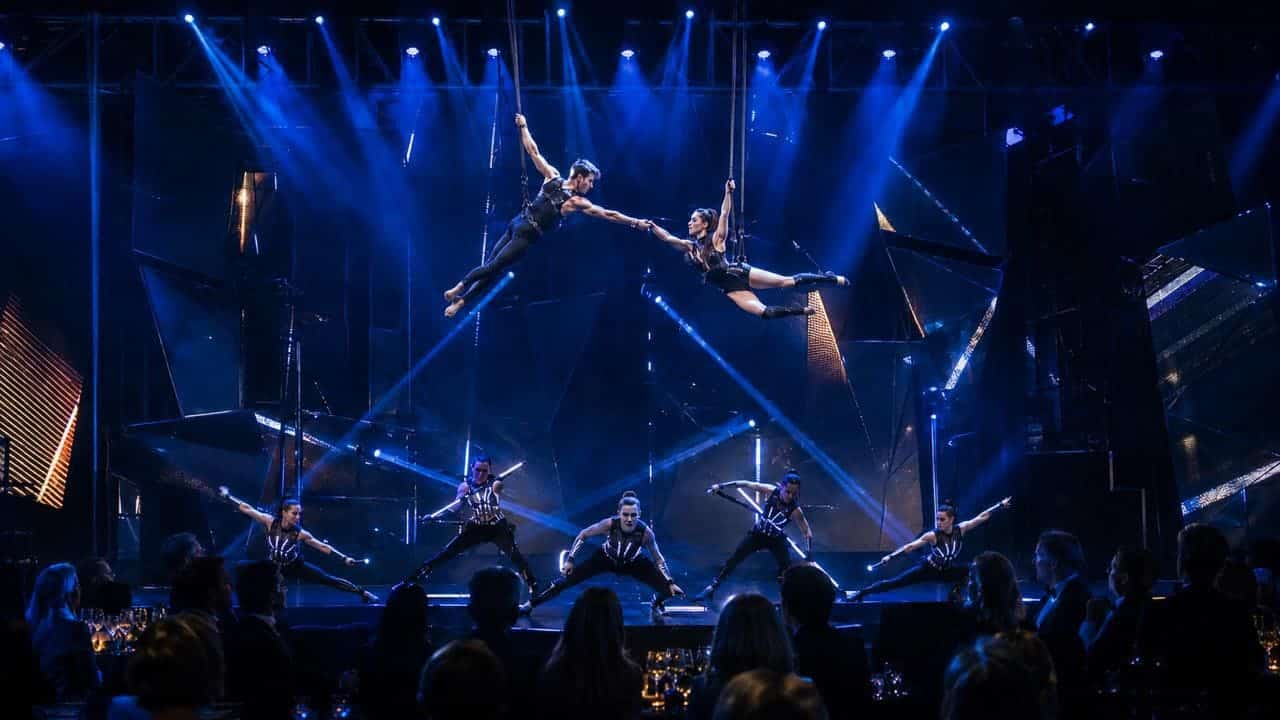
Contemporary circus immediately calls to mind world-class productions built from aerial acrobatics, theatre, music, light, expressive costumes and the sensation of witnessing the impossible. In this visual language, human skill becomes the primary special effect.
For a company, it can also serve as a metaphor for a challenging year. Many achievements may have depended on the team’s ability to maintain balance, trust their partners and support one another at exactly the right moment.
The space can be organised around a circular or oval performance ring placed directly among the guests. Kinetic structures move overhead, aerial artists and projections appear above the ring, and satellite stages operate around its perimeter. The foyer becomes a backstage world: guests glimpse short performances behind translucent drapes, pass through optical installations and try simple circus skills under the guidance of professional artists.
The visual language should sit closer to contemporary theatre and performance art than to traditional circus. Architectural lighting, graphic content, statement costumes and a small number of large scenic elements keep the event elegant and prevent it from becoming a collection of obvious circus tropes.
The climax is strongest when it centres on one specially created set piece. This might be an aerial sequence above the central ring, a fusion of live music and acrobatics, or a light show that transforms the entire room into a single theatrical image.
This concept requires serious technical development. Rigging loads, clear working height, sightlines from every guest area, performer safety systems, load-in time and the rehearsal schedule all influence the choice of venue and the design of the programme.
The direction is well suited to industrial and technology companies, financial services, real estate, retail and large distributed teams. Its scale can range from several choreographed acts in an intimate venue to a full arena production with 360-degree action.
At the End of the Year, People Just Want to Celebrate
No matter how strong the creative idea, people are the point of any December event. By the end of the year, they are tired. They want to switch off, see colleagues outside the office, eat well, laugh, dance and have proper fun.
The concept should therefore be immediately legible and make it easier to relax. Some guests will head towards the stage, some will join the activities, and others will spend half the evening talking. Each person will have their own way of enjoying the event, and each choice is equally valid.
Conclusion:
Concept, scenic design, technology and show direction create the atmosphere. But the real measure of success is whether people have genuinely switched off and gone home energised, still wanting to rewatch the videos on their phones and their colleagues’ social media stories for days afterwards.
Related blogs


Member of the Event Industry Association


a request.
project